

You’re about to learn content marketing for New Zealand businesses from someone who has actually run it — for over a decade, in markets far harder than this one.
The short version of the receipts:
- A sleep-niche content site I worked on peaked at 911,624 organic visits a month
- A fitness and bodybuilding site: 200,193 a month
- HealthVI, built with my SEO mentor Ian Pribyl: 0 to over 20,000 a month
- StoppingScams: over 5,000 visitors a day
- A running-shoe brand you’d have seen on Shark Tank, grown on content
- My YouTube channel: 3.2 million views and 30,000+ subscribers
- My own work has been featured on the Content Marketing Institute — the people who coined the term, and who pull 600,000 visitors a month themselves
That Shark Tank one isn’t a logo on a slide. Here’s the actual thread.

And the Content Marketing Institute mention is the one I’d point at hardest on a page about content marketing, because it’s the organisation that invented the term citing my work.

And Expert SEO, run out of the Waikato, is under a year old and already outranking New Zealand agencies that have been at this for ten.
Every one of those was built on content. Not a dollar of ads between them.
Here’s exactly what you’re getting below:
- What content marketing is, in plain words, and what it looks like on a Tuesday
- How long it takes from a standing start — in real months, not “it depends”
- The three numbers that tell you whether yours is working, and the point at which you should stop
- Whether it still works now that AI answers half the questions before anyone clicks
- Why a 210-search-a-month country changes the entire strategy
Key Takeaways
- What it is: Content marketing is creating genuinely useful content — articles, videos, guides — that attracts the people who’d buy from you and builds enough trust that they do. You earn attention instead of renting it.
- The real payoff is memory. Do it long enough and you become the business your market thinks of first when the problem shows up, which is the cheapest competitive advantage there is.
- Expect 6–12 months from a standing start. First real signals around month three. Anyone promising faster is selling you something.
- Content marketing and SEO are two halves of one job: SEO decides what gets found, content decides whether it’s worth finding.
- Three numbers tell you if it’s working — impressions, clicks, and enquiries that mention a specific piece. All three live in Google Search Console and they move in that order.
- It still works in the AI era, and I can prove it — my content is cited in Google’s AI Mode and in ChatGPT. Being the source AI quotes is the new version of ranking.
- New Zealand is a 210-search-a-month market for this term versus 3.3 million globally. That changes the strategy completely — depth beats breadth here.
What Is Content Marketing?
Content marketing is creating useful content — articles, videos, guides, emails — that attracts the people who would buy from you, and builds enough trust that they eventually do. Instead of paying for attention, you earn it.
That’s the plain version.
The Content Marketing Institute, who more or less coined the term, define it as “a strategic marketing approach focused on creating and distributing valuable, relevant, and consistent content to attract and retain a clearly defined audience — and, ultimately, to drive profitable customer action.”
Fine as far as it goes. But it tells you nothing about what the thing actually looks like on a Tuesday.

So here’s the Tuesday version, from a real New Zealand mortgage adviser.

That’s an 11-minute read called “How Much Deposit Do You Need to Buy a House in NZ? (2026 Guide)”, filed under First Home Buyers, updated June 2026, with a named author on it.
No pitch. No “book a consultation” in the first paragraph. Just the answer to the exact question every first-home buyer in the country is typing at 11pm because they can’t sleep for worrying about it.
Someone finds it. They read the whole thing. They don’t call that night.
Four months later they’re ready to buy, and that’s the name they remember.
That’s it. That’s the entire mechanism.
The advertising version of that same situation is you paying $6 a click to interrupt someone who wasn’t asking. It works, and it stops the second the card declines.
Is a Blog the Same Thing as Content Marketing?
No. The blog is a format. Content marketing is the strategy underneath it.
You can have a blog and no content marketing — that’s the company-news blog, the “we’re excited to announce we’ve moved offices” post that three people read, two of whom work there.
You can also do content marketing with no blog at all. A YouTube channel, a weekly email, a genuinely useful downloadable calculator: all content marketing.
The blog is just the most common vehicle because written content is what search engines rank.
Does Posting on Social Media Count as Content Marketing?
Partly, and this trips up more people than anything else on this page.
Social media is distribution, not content. It’s the road, not the cargo.
If you write a genuinely useful post and share it to LinkedIn, that’s content marketing using social as a channel. If you post a photo of the team at the Christmas party, that’s social media marketing, and it’s a different job with a different purpose.
Here’s one of mine — a LinkedIn post about consulting for a brand that had signed with Mark Cuban’s team on Shark Tank, and what walking into that call actually taught me.
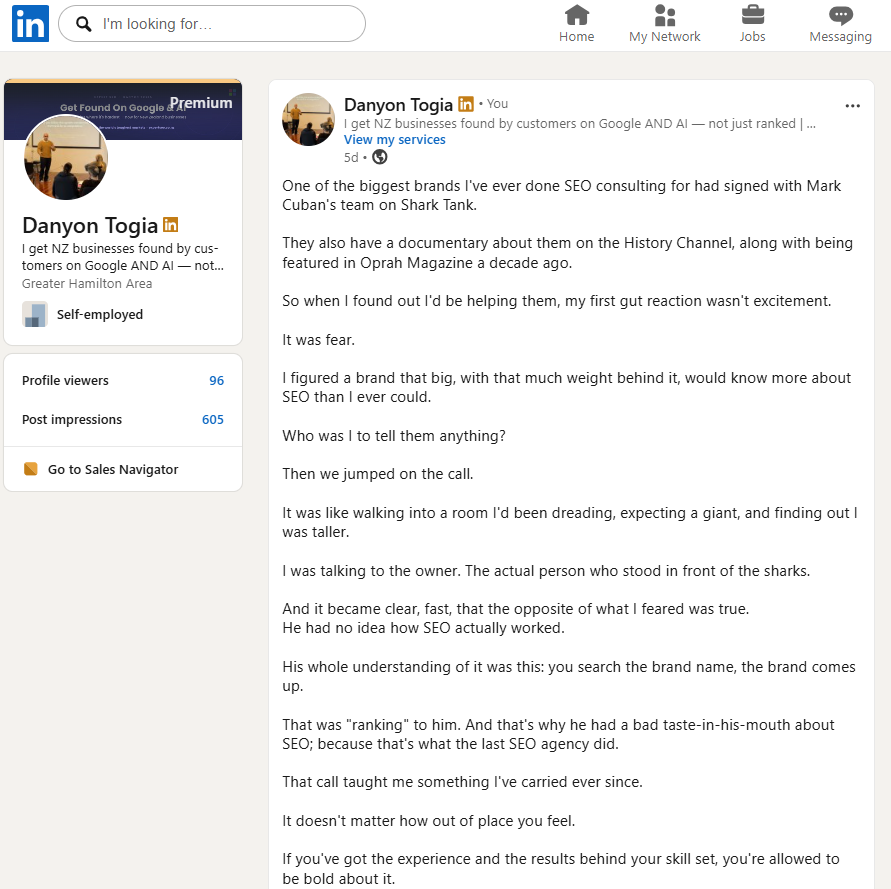
There’s no pitch in it. It’s a story with a lesson on the end, published where my market already is. That’s the same job the article does, wearing different clothes.
The distinction matters because of what happens when you stop. Stop posting on Instagram and your reach is gone in a fortnight. Stop publishing articles and the ones you’ve already written keep bringing people in for years.
One rents attention. The other builds an asset.
Why Is Content Marketing Important?
Content marketing matters because it’s the only marketing channel that keeps working after you stop paying for it. An article that ranks brings in customers for years. An ad stops the day you turn it off.
That’s the headline. But there are four things underneath it, and the fourth is the one almost nobody talks about.
It Builds Trust Before You Ever Ask for Anything
You answer the question before you ask for the sale.
By the time a good prospect contacts you, they’ve read three or four of your articles. They’ve already decided you know what you’re talking about. The conversation starts at “how much” instead of “who are you.”
I’ve had discovery calls where the person had read six of my pages before booking. That call is a different call.
It Compounds in Search
Content is the thing SEO ranks. Without it, there’s nothing to optimise — you’re doing technical work on an empty shelf.
And unlike ads, the curve goes up. A piece published in March is usually doing more traffic in September than it did in April, because it’s had time to earn links, accumulate signals, and pick up long-tail queries nobody predicted.
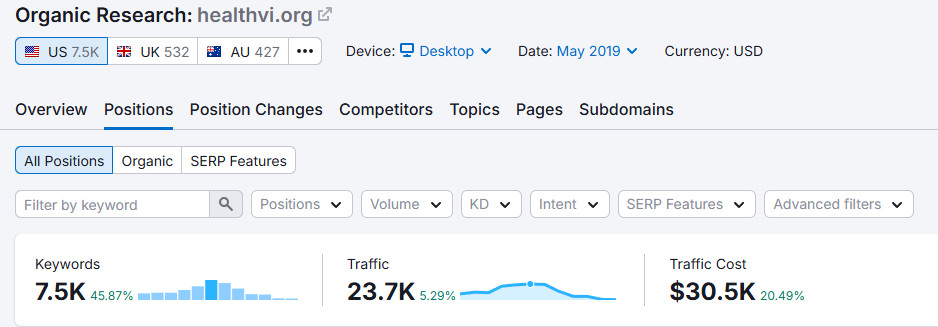
Here’s what that looks like at scale. HealthVI, a site I built with my former business partner and SEO mentor Ian Pribyl, went from zero to over 20,000 visitors a month. Every visitor came from content. We never spent a dollar on ads for it.
A second one, StoppingScams, sits at over 5,000 visitors a day on the same model.

It Earns Links Without You Asking
This is the bit that surprises people.
When you publish something genuinely better than what exists, other people start linking to it on their own. Not because you emailed them. Because it was the most useful thing they found.
One of my direct competitors links to one of my guides. A rival New Zealand SEO business, sending their own readers to my page, because it was the best answer they could point at.
I’ve never spoken to them. Not an email, not a message, nothing.

Try buying that. You can’t, not cleanly. A competitor doesn’t link to you as a favour; they do it because pretending your page doesn’t exist would make their own article worse.
It Makes You the One They Think Of
Here’s the one I actually care about, and it’s the reason I recommend content marketing over almost anything else.
Most marketing is trying to catch people in the two-week window when they’re actively looking. That window is small, crowded, and expensive — everyone’s bidding on it.
Content marketing plays a different game. It works on the other fifty weeks.
Every useful thing you publish is another repetition of the same message to the same market. Someone reads your article in March, sees another in June, watches a video in August. None of those moments produce a sale.
What they produce is a groove. So that when the problem finally shows up — the mortgage, the leak, the legal question — your name is the one already sitting there.
That’s not a soft benefit you write in a strategy deck to fill space; it’s the single most valuable position a small business can hold, and content is the cheapest way I know to get it.
Now the honest part. It’s slow. If you need customers this month, this is the wrong channel — go and run ads, and come back to this when you’ve got breathing room. Anyone who tells you content marketing is a short-term play has never actually run one.
How Does Content Marketing Work?
Content marketing works by meeting people at each stage of their decision — awareness, consideration, decision, retention — with content that does the job that stage needs. A post that’s brilliant at attracting strangers is useless at closing them.
Most people who “try content marketing and it doesn’t work” have made exactly one mistake: they’ve published everything at one stage and wondered why nothing converts.
The 4 Stages of Content Marketing
The four stages are awareness, consideration, decision, and retention. Each one needs a different kind of content, doing a different job.
Here’s what that looks like for our Auckland mortgage broker:
| Stage | What they’re thinking | Content that works |
|---|---|---|
| Awareness | “Can I even afford a house?” | “What Deposit Do You Actually Need to Buy in Auckland in 2026” |
| Consideration | “Should I use a broker or go direct to the bank?” | “Mortgage Broker vs Going Direct: What It Actually Costs You” |
| Decision | “Is this broker any good?” | Case studies, a walkthrough of your process, real client outcomes |
| Retention | “Should I refix or refinance?” | Annual rate-review guides, an email that lands before their fixed term ends |
Awareness content is what brings volume. Decision content is what turns it into money. You need both.
The classic failure is a blog stuffed entirely with awareness pieces and a website with nothing that helps someone actually choose you. Loads of traffic, no enquiries, and a business owner concluding content marketing doesn’t work.
It worked. It just stopped one stage short.
Types of Content Marketing
The main types are written (blogs, guides, newsletters, case studies), visual (infographics, comparison tables), video (YouTube, short-form), and audio (podcasts, webinars). For a small NZ business with no team, they are nowhere near equal on effort-to-return.
Every guide lists these. Almost none of them tell you which ones are worth your Tuesday afternoon.
So here’s the ranking, based on what I’ve actually run:
| Type | Effort | Time to first return | How long it lasts | Verdict |
|---|---|---|---|---|
| Written (search-led) | Medium | 3–6 months | Years | Start here. Highest return per hour by a distance. |
| Case studies | Low | Immediate | Years | Wildly underrated. You already have the material. |
| Low | Weeks | Ongoing | Best ROI once you have an audience. Useless before. | |
| Video (YouTube) | High | 6–12 months | Years | Powerful, and a genuine second search engine. Only if you’ll stick at it. |
| Short-form social | Medium | Days | Days | Fast, and gone by Thursday. |
| Infographics | Medium | Varies | Years | Good for links, weak for leads. |
| Podcasts | Very high | 12+ months | Ongoing | Highest effort, slowest return. Almost nobody should start here. |
A single article that ranks will outlive ninety Instagram posts. That’s not a dig at social — it’s a statement about where the compounding is.
On video: I’m not talking that down from the cheap seats. My YouTube channel has done 3.2 million views and sits over 30,000 subscribers, so I know exactly what it returns.
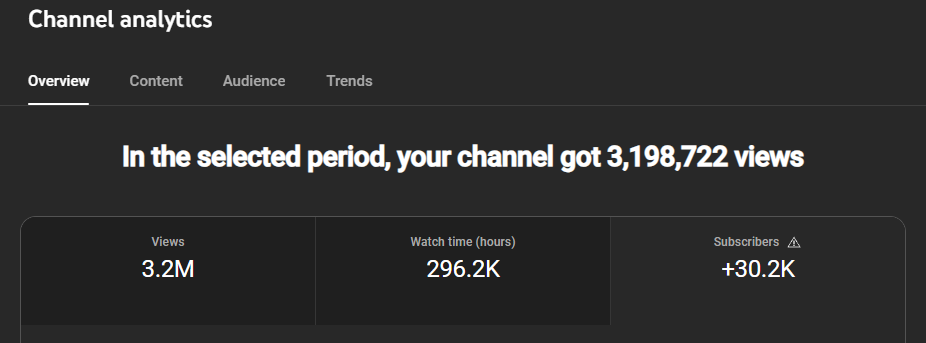
It also took years, and it’s the format most people quit first. Worth doing. Not worth doing first.
Should You Start With Writing or Video?
Start with whichever one you’ll still be doing in six months.
That sounds like a cop-out. It isn’t — it’s the only variable that actually predicts the outcome. Consistency beats format every time, and the format you secretly dread is the one you’ll abandon in March.
If you genuinely have no preference, start with writing. It’s cheaper, faster to produce, and it’s what search engines rank.
How Content Marketing and SEO Work Together
SEO decides which content gets found. Content marketing decides whether it’s worth finding. Do the first without the second and you have a technically perfect site nobody wants to read; do the second without the first and you’ve written a newsletter nobody discovers.
They’re two halves of one job, and treating them as separate disciplines is where a lot of money gets wasted.
What SEO brings: the keyword research that tells you what people are actually searching for, and the technical work that lets your pages rank once they exist. If you’ve never had the whole discipline explained end to end, that’s the piece worth understanding before you write anything.
What content brings: the actual thing that ranks, and the reason anyone links to you.
The most common failure I see on NZ websites is a business writing what it wants to say instead of what’s being searched. Six beautifully written articles about their company philosophy, zero about the question their customers type into Google at 11pm.
Keyword research isn’t a constraint on your creativity. It’s the difference between writing into a room and writing into a void.
This is also the half most business owners end up handing over, and I’d say fairly. The writing you can learn — you know your industry better than any agency will.
The keyword strategy and the technical side are the parts that punish guessing, which is why professional SEO services tend to pay for themselves fastest right here rather than on the writing.
How to Do Content Marketing
Content marketing runs on seven steps: define who it’s for, find what they’re searching, choose the format, build a rhythm, write it properly, distribute it, and measure it.
I’m going to run all seven on one real example rather than describe them in the abstract — our Auckland mortgage broker, start to finish.
Step 1: Define Who You’re Writing For
Not a persona document. One sentence naming the person and their problem.
First-home buyers in Auckland, aged 28–40, who think they can’t afford a deposit and haven’t checked properly in two years.
That’s it. If you can’t write that sentence, no amount of content will save you, because you don’t know who you’re talking to.
Notice the city sitting in there. A broker chasing every first-home buyer in the country is competing with the banks; one going after Auckland only is competing with a handful of local advisers, and that’s a fight worth having.
It’s the same reason SEO in Auckland is a different job from SEO nationally — narrow the geography and a losing fight becomes a winnable one.
The test: could you picture one specific real person who fits? If not, it’s too broad.
Step 2: Find What They’re Searching For
This is where most people skip straight to writing, and it’s the most expensive skip in the whole process.
Free method, no subscription:
- Open Google in an incognito window and set your location to New Zealand
- Type your topic and watch the autocomplete suggestions — those are real queries
- Search it, then scroll to “People also ask” and “Related searches” at the bottom
- Write down every question that appears
That alone will give you twenty article ideas in fifteen minutes.
Paid method, if you have the budget: Google Keyword Planner is free with an Ads account and gives you volume ranges. Semrush or Ahrefs give you difficulty scores and the full question list — around $200 NZD a month each, which is worth it once you’re publishing regularly and not before.
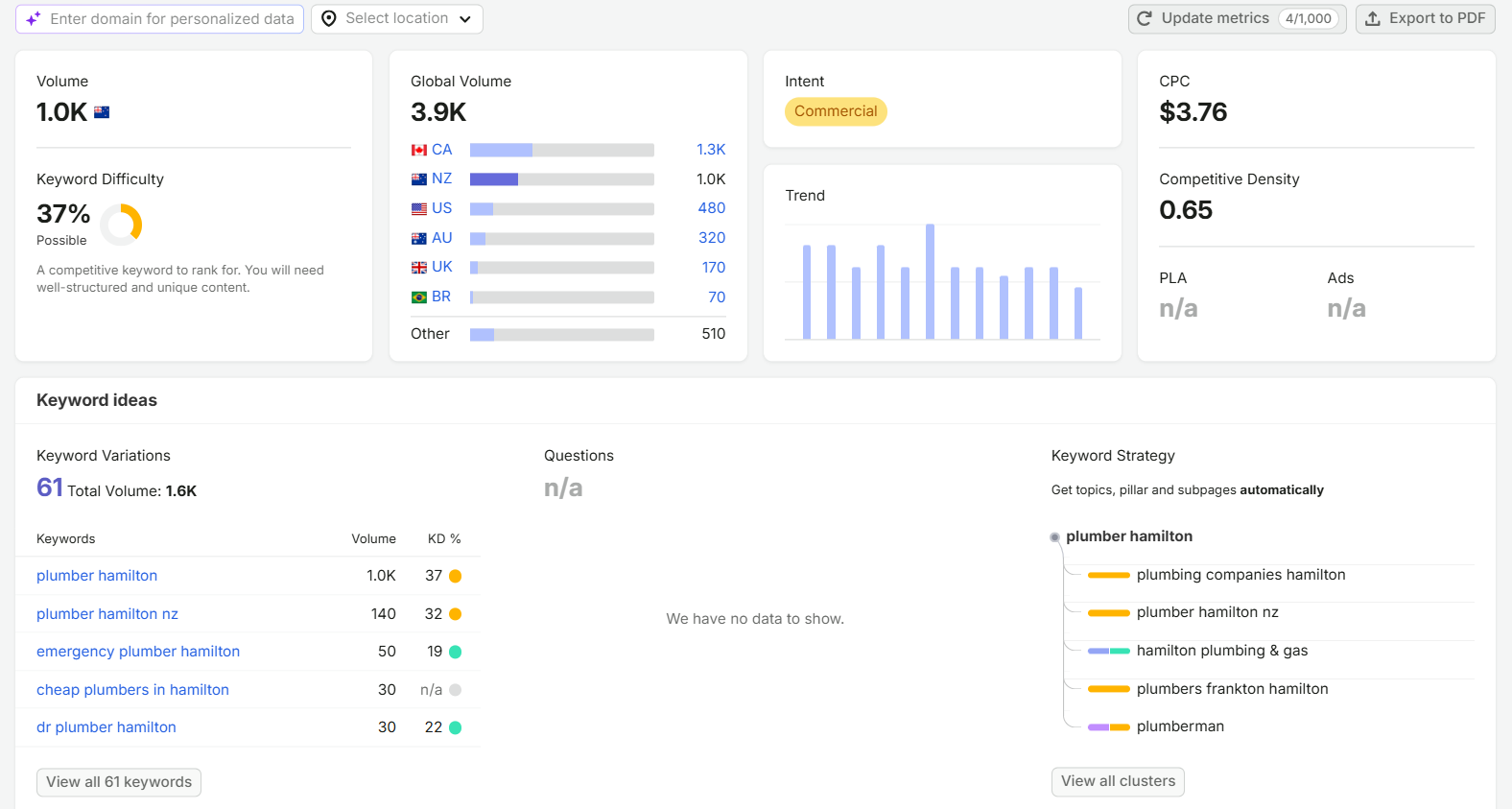
Here’s the shape of what comes back for our broker (illustrative figures — your own numbers will differ, but the pattern won’t):
| Keyword | NZ volume | Difficulty | Intent |
|---|---|---|---|
| first home buyer deposit nz | 480 | Low | Informational |
| mortgage broker auckland | 720 | Medium | Commercial |
| how much deposit do i need nz | 260 | Low | Informational |
| mortgage broker vs bank nz | 90 | Low | Commercial |
Those are small numbers by international standards. They’re also people in Auckland with a specific problem, and 260 of the right people beats 26,000 of the wrong ones.
The column that matters most there is the last one. What someone intends when they type a phrase decides what you write for it — a “how much” question wants an article, a “broker near me” question wants a service page, and mixing those up is how good content ends up converting nobody.
Step 3: Choose the Format
Back to the effort-to-return table. For a broker: written, search-led, plus case studies.
The deposit question is a search query, so it wants an article. The “should I use a broker” question is a decision-stage question, so it wants an article plus a real client walkthrough sitting next to it.
Skip video for now. Revisit in year two.
Step 4: Build a Rhythm You Can Hold
One piece a fortnight, held for a year, beats eight pieces in January.
I’d rather a business commit to twenty-six solid articles across a year than sprint out ten in six weeks and go quiet. Search engines reward the pattern, and more importantly, so does your own follow-through.
Pick the cadence you can hold on your worst week, not your best one. Then put it in the calendar as a recurring block, treated like a client meeting you can’t move.
Step 5: Write It So It’s Worth Finding
The bar is simple: could someone get this exact thing from a generic ChatGPT prompt?
If yes, it’s not finished. That’s the test I run on every section of every article I publish, including this one.
What gets you past it:
- Answer the question in the first two sentences. No throat-clearing, no “in this article we’ll explore.”
- One specific claim per section, with a real number attached where one exists
- A worked example with real detail — not “a business in a major city” but “a mortgage broker in Mount Eden”
- Your own experience, including the parts that didn’t work
- Original data if you have any. Even small: your own client averages, your own pricing, what you’ve observed across fifty deals
The last one is your unfair advantage. You have data no international content mill can get: what actually happens in your market, with your customers.
Step 6: Distribute It
Publishing is not distributing. This is the single most common failure in content marketing and it’s why a lot of good work sinks.
The rule of thumb I use: for every hour writing, spend half an hour getting it in front of people.
For our broker, that half hour is:
- Post it to LinkedIn with the actual insight in the post — not “new blog post, link in comments”
- Email it to the existing client list, because past clients refer
- Send it directly to three people who’d genuinely find it useful (a real estate agent, a conveyancer, a past client mid-refix)
- Answer the same question on a relevant forum or Facebook group, and link it only where it’s genuinely the best answer
That’s it. Nothing clever. But the article that gets ninety minutes of promotion beats the better article that got none, every time.
Step 7: Measure It
Short version: three numbers, checked monthly, in Google Search Console.
Long version is the next-but-one section, because it’s the part nobody else writes properly.
How Long Content Marketing Takes to Work
Starting from nothing, expect six to twelve months before content marketing produces meaningful leads, with the first real signals around month three. With an established site, three to six months. Anyone promising faster is selling you something.
This is the question every competitor dodges, so let me give you the version with actual months attached.
Starting From Zero
Months 1–3: it looks like nothing is happening. Because roughly, nothing is. You’re publishing into a void. A handful of impressions. Almost no clicks. This is where the overwhelming majority of people quit, and it is precisely the wrong moment to.
Months 3–6: impressions start moving. You’ll see pages appearing for searches you didn’t target. Clicks stay low. This is the first genuine signal, and it’s easy to miss if you’re only watching visitor counts.
Months 6–12: clicks follow, then enquiries. Somewhere in here the first person contacts you and mentions an article by name. That’s the moment it becomes real.
I’m not theorising here. Expert SEO is under a year old, and it’s competing against agencies that have been building authority since before I owned the domain.
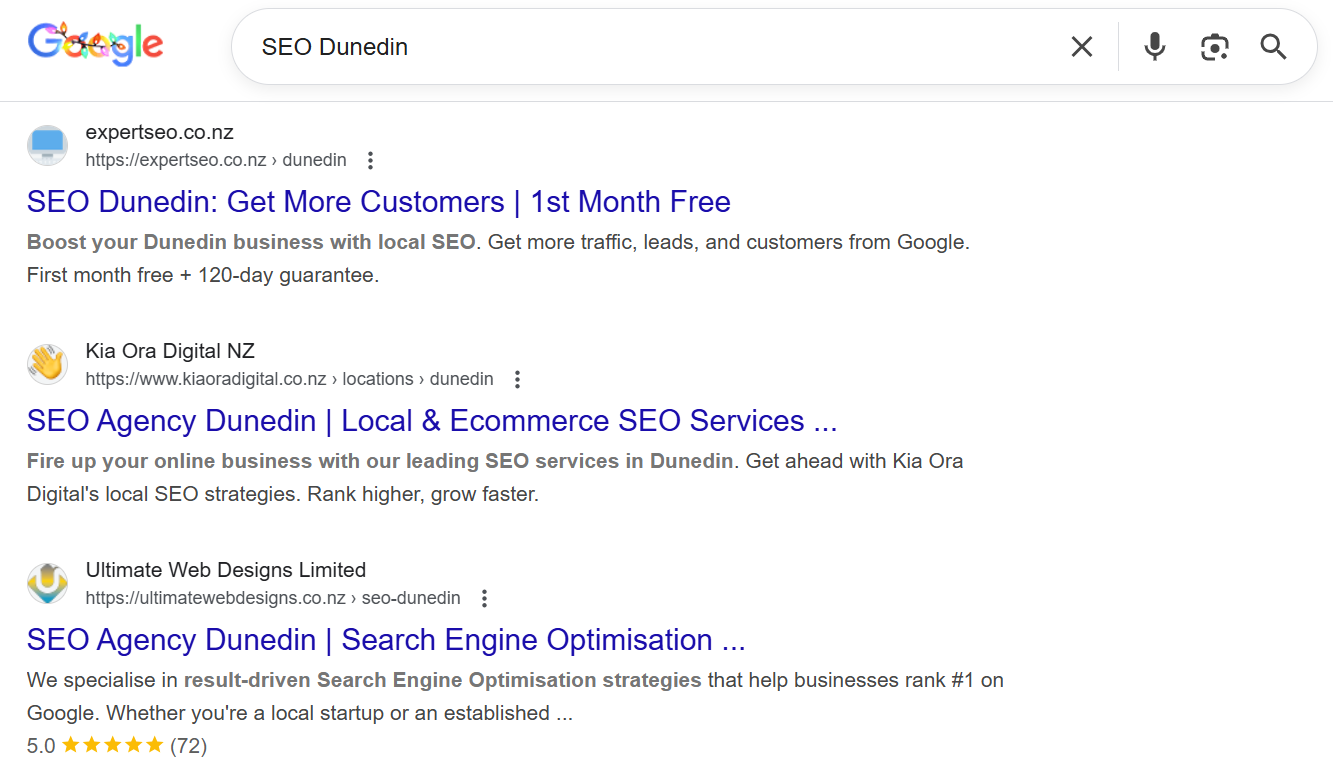
It ranks #1 for “SEO Dunedin” — a city I’ve never set foot in as a business, won purely on the strength of the page and the site’s authority.
It ranks #2 for “SEO Hamilton”, in a market with far more established competition.

And in roughly eight months the domain went from nothing to 233 keywords and about $3,500 a month in traffic value.
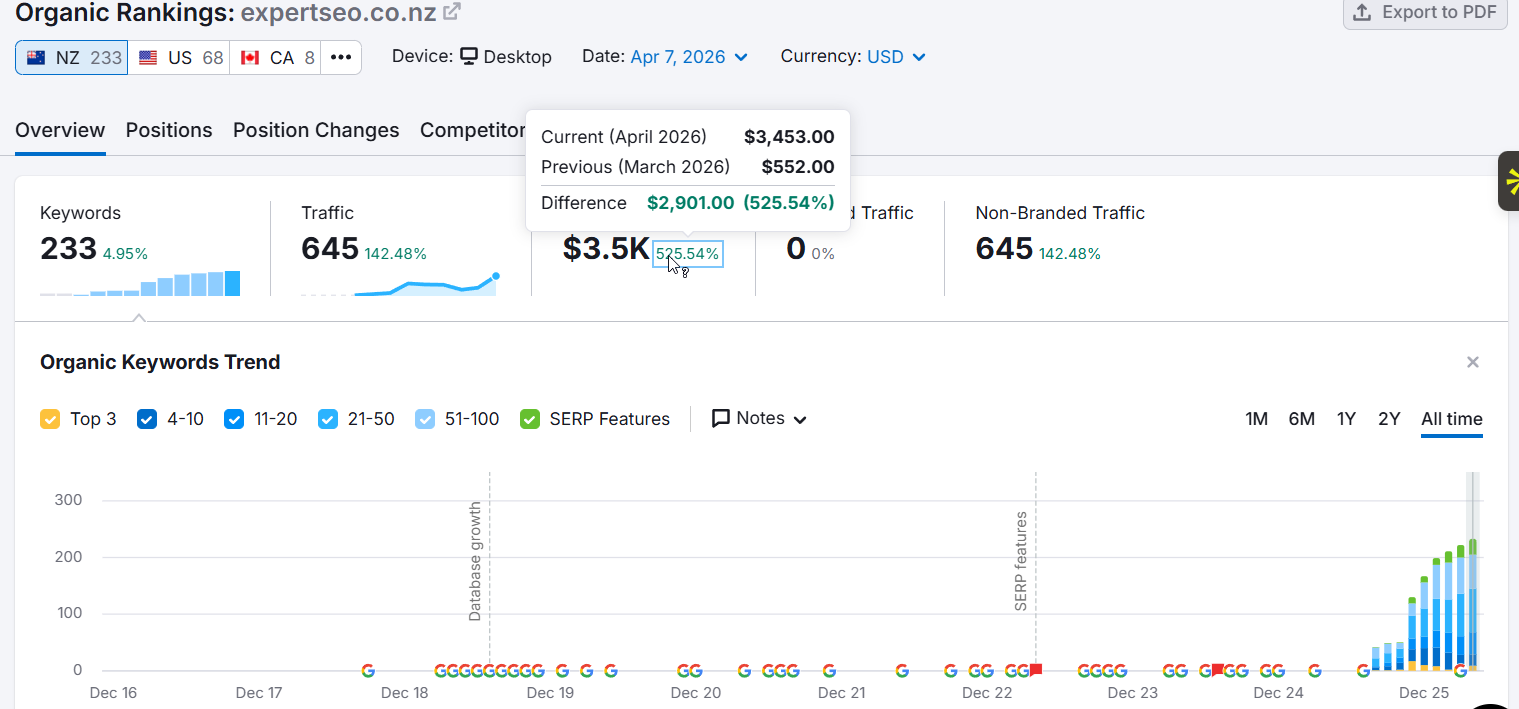
On paper, no chance. In practice: months of publishing, into a market where the competition had gone stale.
And HealthVI, the 0-to-20,000 site? That took the better part of two years, and it had an experienced operator on it full time. I’d rather tell you that than sell you a fantasy where it took eight weeks.
Starting With an Established Site
Faster, usually three to six months, for one reason: you already have domain authority. Your new page inherits trust the brand-new site has to earn from scratch.
If you’ve had a website for five years and never published anything useful on it, you’re in a better position than you think. The foundation is already there.
What Speeds It Up and What Slows It Down
Faster: existing authority, a niche nobody’s serving properly, genuine subject expertise, consistent publishing, one topic covered deeply rather than fifteen covered shallowly.
Slower: a brand-new domain, a saturated topic, publishing in bursts, writing what you want to say instead of what’s searched, thin content that technically exists but answers nothing.
What Content Marketing Costs in New Zealand
Outsourced content marketing in New Zealand runs roughly $1,500 to $10,000+ a month depending on volume and whether strategy is included. Done yourself, budget four to six hours a week — that’s the cost nobody quotes you.
Let’s do both honestly.
The Outsourced Range
- $1,500–$3,000/month: two to four articles, basic keyword research, minimal strategy. Fine if you know what you want written.
- $3,000–$6,000/month: the common middle. Strategy, research, writing, on-page optimisation, some distribution.
- $6,000–$10,000+/month: full programme — content plus technical SEO, digital PR, and link acquisition.
What $500 a Month Actually Buys
This gets asked constantly and always gets either an upsell or a shrug, so: $500 a month buys you roughly one properly researched article.
That’s not nothing. Twelve genuinely good articles in a year, on twelve well-chosen questions, will do real work for a small local business.
What it won’t buy is strategy, distribution, or technical fixes. At that budget you’re buying writing, and you’re doing the thinking yourself — or paying an SEO consultant for a few hours to set the direction and then running it on your own.
My honest advice at $500: spend it on one good article a month and do your own keyword research using the free method above. Don’t spread it across four cheap ones.
The DIY Cost, in Hours
Four to six hours a week. Realistically:
- 1 hour: research and choosing the topic
- 2–3 hours: writing and editing
- 30 minutes: publishing, images, formatting
- 30–60 minutes: distribution
That’s one article a fortnight without wrecking your week. Hold it for a year and you’ll have twenty-six assets working for you permanently.
What Cheap Content Actually Costs
The $50-an-article maths never works out. I’ve watched it play out enough times to call it: you pay $50, you get 800 words of generic filler, it ranks for nothing, and eight months later you pay someone properly to rewrite it.
So the real cost was $50 plus the rewrite plus eight months of nothing.
How to Tell If Your Content Marketing Is Working
Three numbers tell you whether content marketing is working: impressions, clicks, and enquiries that mention a specific piece of content. Check them monthly in Google Search Console. If impressions are flat after six months of consistent publishing, the problem is your strategy, not your effort.
Nobody writes this section, which is strange, because it’s the thing people are most desperate to know. I’ve read the forum threads — people publishing for a year, no idea whether they’re early or wrong, nobody giving them a straight answer.
Here’s the straight answer.
The Three Numbers and Where to Find Them
Open Google Search Console (free), verify your site, and go to Performance → Search results. Set the date range to the last 6 months and tick all four boxes at the top.
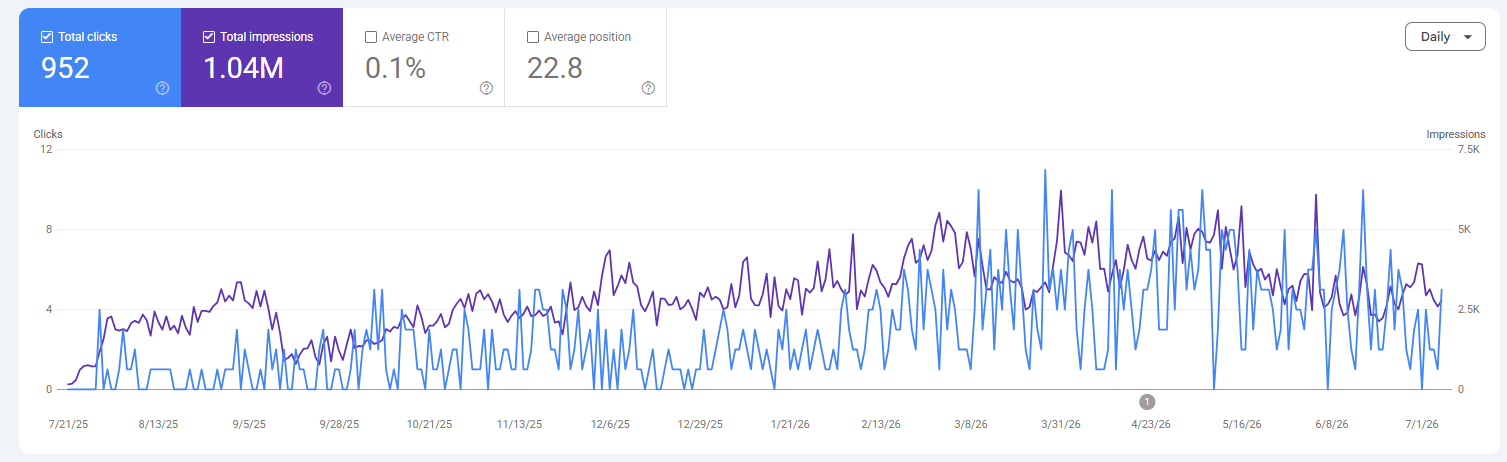
1. Impressions. How many times your pages appeared in search results. This is the leading indicator — it moves first, and it moves before anything good happens.
2. Clicks. How many people actually came. This follows impressions by roughly two to three months.
3. Enquiries that name a piece of content. Add “how did you hear about us?” to your contact form, or just ask on the call. This is the one that pays your mortgage, and it’s the last to move.
Why They Move in That Order
Google shows your page to a few people first. If they engage, it shows it to more. Impressions climb while clicks stay flat, because you’re ranking on page three where nobody clicks.
Then you cross into positions where people actually click, and the clicks arrive in a lump.
Getting this wrong is why people panic at month four. They’re watching clicks — the number that moves last — and concluding nothing is happening, while impressions have quietly tripled.
Watch impressions. Clicks are a lagging indicator of a decision Google already made.
How to Attribute a Lead Without Enterprise Software
You can’t do proper multi-touch attribution as a small business, and you don’t need to. Three things get you 90% of the way:
- The “how did you hear about us?” field. Free, and people answer honestly.
- Search Console’s Pages tab. Sort by clicks. Whichever pages bring traffic are your workers.
- Ask on the call. “Did you read anything on the site before getting in touch?” You’ll be surprised how specific the answers are.
Someone will typically read three to five pieces before contacting you. Trying to credit one is a fool’s errand — you’re looking for the pattern, not the culprit.
When to Stop
Nobody gives you a kill criterion, so here’s mine.
Keep going if: impressions are trending up, even slowly. Some pages rank for something, anything. You’ve published consistently for less than nine months.
Change strategy if: you’ve published consistently for six-plus months and impressions are genuinely flat. That’s not a patience problem. Almost always it’s one of three things — you’re writing about topics nobody searches, you’re targeting keywords far too competitive for your site, or the content is too thin to compete.
Stop and reassess entirely if: you’ve been at it twelve months with real consistency, real quality, real distribution, and there is nothing. No impressions, no rankings, no enquiries.
At that point either the market isn’t searching for what you do, or something technical is broken — and a proper site audit will tell you which in an afternoon, which beats another six months of writing into the same wall.
That’s a diagnosis, not a death sentence. But it’s a real answer, which is more than “just be patient.”
Why Content Marketing Fails
Content marketing rarely fails from lack of effort. It fails for five specific, predictable reasons — and “not working hard enough” isn’t one of them.
1. Publishing With No Goal
Content gets treated as a box to tick. Something goes up every week with no target keyword, no defined reader, no idea what it’s meant to achieve.
The result is a stream of low-engagement posts that no strategy could rescue.
2. Expecting It to Behave Like Advertising
This is the big structural one.
Businesses run content the way they run ads: publish, wait a fortnight, check for sales, conclude it’s broken. But ads rent immediate attention while content builds compounding attention, and judging one by the other’s timeline guarantees you quit before the return arrives.
3. No Distribution
Covered above, and worth repeating because it’s the most common single cause. People publish and stop. The article sits there. Nobody links it, nobody shares it, and it never gets the early signals it needs.
4. Writing for Yourself Instead of for Search
Company news, award announcements, office moves. Nobody searches for these.
Every article should map to a real question a real person types. If you can’t name the query, don’t write the piece.
5. Quitting at Month Four
Month four is where most people stop. Month four is also roughly where it starts.
Consistency is the first thing that breaks when you’re doing this solo — long before quality does. You miss a fortnight because a big job lands, then a month, then it’s been a quarter and starting again feels harder than starting did.
If you take one thing from this section: protect the calendar before you protect the word count.
The Self-Test
“Content marketing isn’t dead, lazy content marketing is dead” is a line everyone repeats and nobody operationalises. So here’s how to tell which one yours is.
Pick your last three articles and check:
- Can you name the exact search query each one targets? (If no — it’s the lazy kind.)
- Does each contain a number, example, or detail no competitor could have written? (If no — lazy.)
- Did each get at least thirty minutes of promotion after publishing? (If no — lazy.)
- Would you send it to a client as a genuine answer to their question? (If no — lazy.)
Four yeses and you’re doing the real thing and need patience. Two or fewer and you don’t have a patience problem; you have a quality problem, and more time won’t fix it.
Does Content Marketing Still Work With AI Search?
Yes — but the payoff has shifted. AI Overviews genuinely do take clicks off informational searches. At the same time, AI systems have to cite someone, and being that source is the new version of ranking.
Let me give you the bad news first, because every other page on this topic softens it and that’s exactly why nobody believes the rest of their answer.
The Bad News Is Real
AI Overviews sit above the results and answer the question outright. If your article existed to explain what a mortgage broker does, and Google now explains it in three lines at the top of the page, your click is gone.
This is measurable, and the numbers are blunt. Semrush found that when Google shows an AI summary, only 8% of users click through to a normal result — against 15% when there’s no summary. That’s roughly half your clicks gone on the queries where an AI Overview fires.
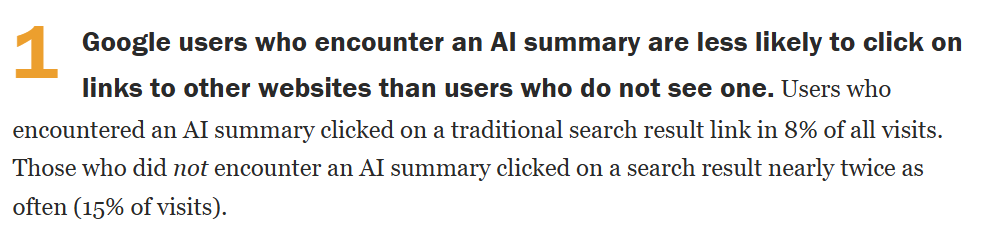
Anyone telling you AI hasn’t changed anything is either not looking at their own data or not being straight with you.
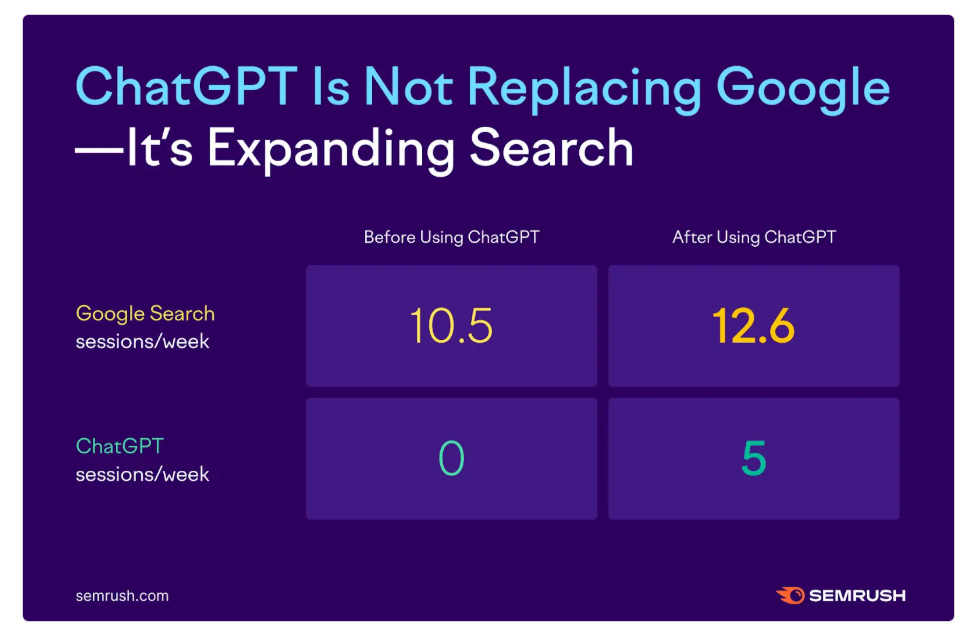
Worth keeping in proportion, though. Semrush also found Google sessions per week rose from 10.5 to 12.6 after people started using ChatGPT — AI is expanding how much people search, not simply replacing it.
The Good News, With Proof
AI systems don’t invent answers from nothing. They synthesise sources, and they name them.
My content is cited in Google’s AI Mode and in ChatGPT responses. Not a site that’s been building authority for a decade — one under a year old, run out of the Waikato.
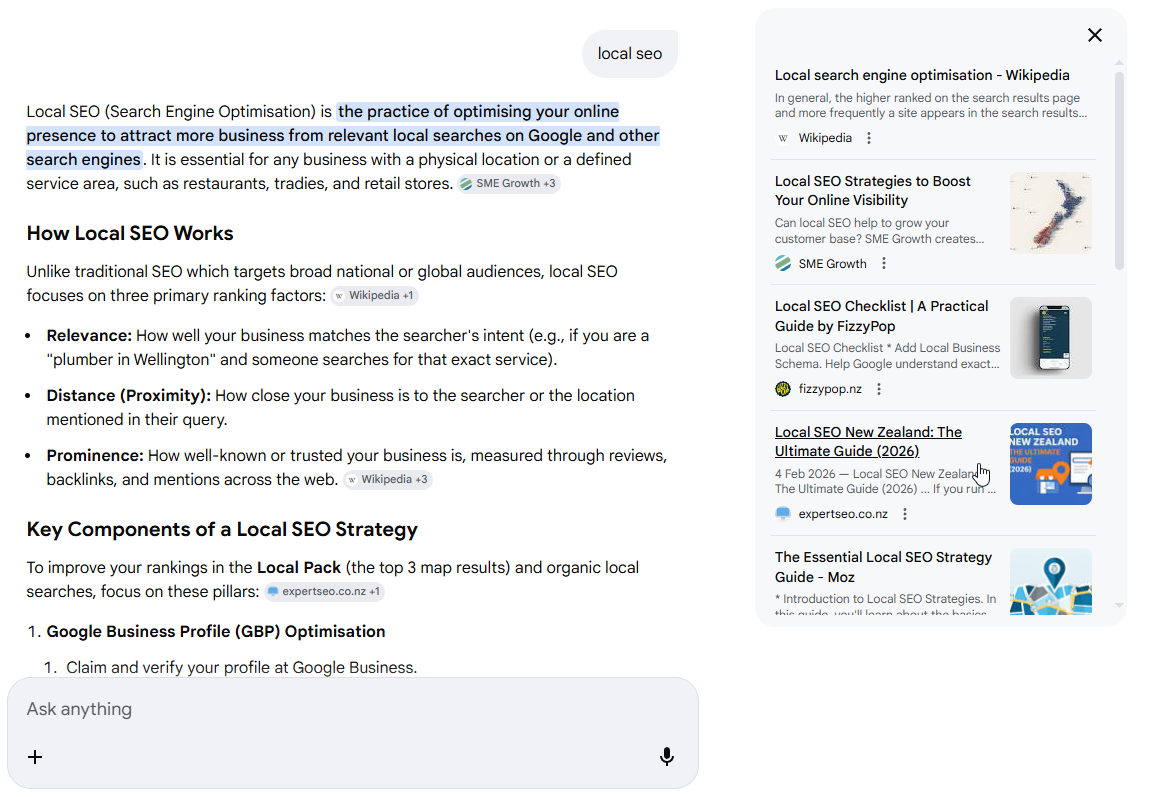
That’s the whole opportunity in one screenshot. Beating a DR 96 domain to position one is not realistic for a small NZ business. Being the source an AI reaches for is absolutely realistic, because AI systems select for usefulness and specificity, not domain age.
And notice what that is, structurally: it’s the same recall argument from earlier, running on machines instead of people. Publish enough genuinely useful, specific answers and you become the thing that gets recalled — first by your market, now by the models your market asks.
How to Write Content AI Systems Cite
From what’s actually worked on my own pages:
- Answer the question directly in the first one or two sentences under each heading. AI systems lift clean, self-contained answers.
- Use specific numbers over vague claims. “Six to twelve months from a standing start” gets quoted; “it takes a while” doesn’t.
- Include original data. Your own figures can’t be sourced anywhere else, which makes you the only citable option.
- Structure clearly. Real H2s, one idea each, no clever headings that hide what the section is about.
- Cover the topic completely. Models favour sources that answer the whole question, not a fragment.
If that sounds like a description of the article you’re currently reading, that’s not an accident.
What Doesn’t Work
Posting stealth marketing content to Reddit and forums hoping to get scraped into AI answers. Reddit is now actively removing this stuff, and platforms are getting sharper at spotting it fast.
It’s a dead tactic. Don’t build on it.
What This Changes About Strategy
Stop measuring clicks alone. That number is going to look worse every year regardless of what you do, because a growing share of searches now end without anyone clicking anything.
Start watching two more things: whether you’re being cited in AI answers (search your topics in ChatGPT and Google AI Mode and see who gets named), and whether branded search for your business is rising.
If people are hearing about you and searching your name directly, the content is working — even if the click count says otherwise.
Content Marketing for New Zealand Businesses
“Content marketing” gets about 210 searches a month in New Zealand. Globally it’s 3.3 million. That gap isn’t trivia — it changes the entire strategy, and it’s why international advice keeps failing here.
Every guide you’ve read on this topic was written for a market with a thousand times the volume. They assume budget, team, and search demand you don’t have.
The Volume Reality
Here’s the actual NZ data for this topic:
| Keyword | NZ volume | Global volume |
|---|---|---|
| content marketing | 210 | 3,300,000 |
| content marketing nz | 40 | — |
| content marketing agency auckland | 30 | — |
| what is content marketing | 30 | 120,000+ |

Two hundred and ten. That’s the head term for an entire industry, in a whole country.
What That Changes
Chasing head terms is a losing game. Twenty searches a month on a term that converts beats a thousand that don’t. In a market this size, you win on specificity, not volume.
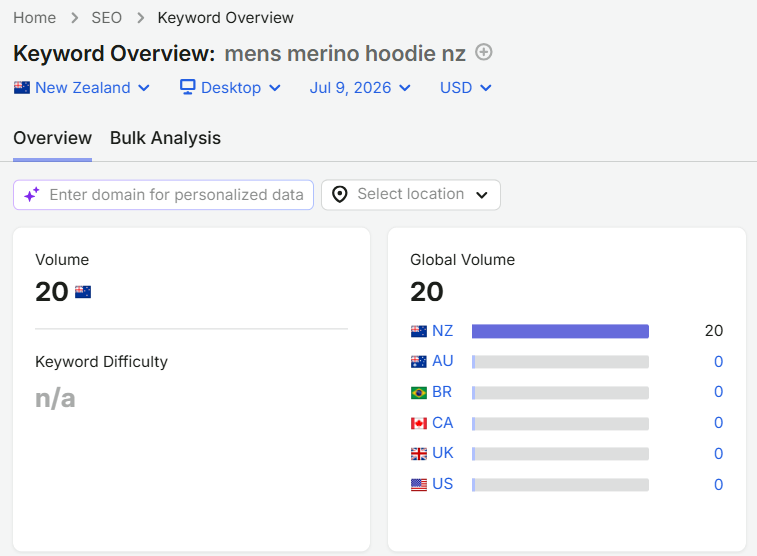
Here’s a real one: “mens merino hoodie nz” does 20 searches a month. Twenty. But every single person typing that is holding a credit card, which makes it worth more than a thousand people idly reading about wool.
Depth beats breadth. Rather than fifty shallow articles across your whole industry, cover one area completely. Ten genuinely thorough pieces on one topic will outperform fifty thin ones, because search engines increasingly reward being the definitive source on something rather than being adequate on everything.
The long tail is the whole opportunity. “Content marketing” is 210. But the variations, the questions, the “how do I actually” queries add up to thousands of searches from people much closer to buying.
Add a city to any of them and the maths improves again, because you stop competing with the whole country.
Take my own market. Nationally, “SEO” is a bloodbath — I’m not winning that this year or next.
But these are four completely different searches:
Each one has a much shorter queue in front of it. Same industry, four winnable fights instead of one unwinnable one.
Whatever you sell, the equivalent split exists in your market too.
Why NZ Is Easier Than You Think
Here’s the part that should encourage you.
The competition on most New Zealand search terms is thin. Not because Kiwi businesses are lazy, but because most haven’t bothered — and a lot of what has been published has gone stale.
I found this researching this very article. One NZ agency page ranking for this term carries a banner from the agency itself saying the content is out of date and “being updated soon.” It’s been sitting there since 2023.
Another is 750 words of generic advice with “New Zealand” dropped in three times.
That’s what you’re up against. In the US I’d be fighting sites with thousands of referring domains for the same term. Here, most NZ terms are a genuinely open field — which is, frankly, the reason a one-year-old Waikato site can rank #1 in Dunedin.
(Not something I’d have got away with in the American market, where you can publish something excellent and still be on page four by Friday.)
Content Marketing for a Small NZ Business With No Marketing Team
This is where content marketing and SEO for small businesses stop being separate line items and become the same weekly habit.
The realistic version: one person, four hours a week, no budget for tools.
- Use the free keyword method — incognito Google, autocomplete, People Also Ask
- Write one genuinely good article a fortnight on a question your customers actually ask
- Spend thirty minutes promoting each one
- Check Search Console monthly and watch impressions
- Keep going for twelve months before you judge it
That’s the entire programme. It’s not complicated. It’s just genuinely hard to keep doing, which is precisely why it still works.
The one NZ business I’ve seen publish real numbers on this — a Nicholson Autos campaign run through NZ Digital — reported a 132% increase in enquiries and 42% more organic traffic. Credit where it’s due: that’s the only other real result I found on this entire search page.
Final Thoughts
If you forget everything else here, keep this:
Content marketing is the vehicle for becoming the business that comes to mind when your market thinks about the problem you solve.
Not the business that shows up when they search. The one they already thought of before they searched.
You get there through repetition of message. Same market, same problem, answered again and again, in public, until the association sets. That’s not a clever tactic — it’s how memory works, and it’s been how memory works since long before Google existed.
What makes content the best vehicle for it is the maths. An ad rents that association for as long as you keep paying. An article builds it once and holds it for years. Pound for pound it’s the highest-return thing I know of for a small business, and it keeps paying back long after you’ve stopped thinking about the piece that started it.
The catch, and I’d be lying if I skipped it: it asks for the one thing nobody wants to give it, which is time before the payoff.
Twelve months of consistent, genuinely useful publishing will put a small New Zealand business in a position that no advertising budget can buy. Six weeks will do nothing at all.
Most people quit somewhere in between.
If it were my money and I had a year, I’d pick one question my customers ask constantly, answer it better than anyone in the country has, then do that twenty-five more times.
That’s the whole strategy. The rest is calendar management.
Content Marketing: FAQ
What does content marketing mean in simple words?
Content marketing means creating useful things — articles, videos, guides, emails — that attract the people who would buy from you and build enough trust that they eventually do. You earn attention by being helpful instead of paying to interrupt people.
What does content marketing include?
Written content (blog posts, guides, case studies, newsletters), visual content (infographics, comparison tables), video (YouTube, short-form) and audio (podcasts, webinars). It also includes the work around the content: keyword research, planning, distribution and measurement.
What are the 4 stages of content marketing?
Awareness, consideration, decision and retention. Awareness content attracts strangers, consideration content helps them compare options, decision content helps them choose you, and retention content keeps existing customers coming back.
What are the 3 C's of content marketing?
Content, context and consistency — make something useful, put it where it fits, and keep doing it. Of the three, consistency is the one that decides outcomes; steady publishing beats brilliant publishing done in bursts.
What are the 5 C's of content marketing?
Clarity, consistency, creativity, customer-focus and conversion. It's an expanded version of the 3 C's, and in practice it's a checklist rather than a strategy — useful for reviewing a piece, not for deciding what to publish.
What is the difference between content marketing and digital marketing?
Digital marketing is the whole category — paid ads, email, social, SEO and content. Content marketing is one channel inside it: the practice of earning attention with useful content rather than buying it.
What is the difference between content marketing and SEO?
SEO decides which content gets found; content marketing decides whether it's worth finding. SEO supplies the keyword research and technical work, content supplies the thing that actually ranks. Neither works properly without the other.
Are podcasts content marketing?
Yes, if the podcast exists to attract and build trust with the people who'd buy from you. It's also the highest-effort, slowest-returning format on the list, so it's rarely the right place for a small business to start.
How much does content marketing cost in New Zealand?
Outsourced, roughly $1,500 to $10,000+ a month depending on volume and whether strategy is included. Around $500 a month buys about one properly researched article. Done yourself, budget four to six hours a week.
How long does content marketing take to work?
From a standing start, six to twelve months for meaningful leads, with the first real signals around month three. On an established site with existing authority, three to six months. Anyone promising faster is selling something.
Will content marketing be replaced by AI?
No, but the payoff has shifted. AI Overviews reduce clicks on simple informational searches, while AI systems still have to cite sources. Being the source AI quotes is the new version of ranking, and it favours specific, original, well-structured content.
Can content marketing increase sales?
Yes, though rarely in the way ads do. Content works by being there before someone is ready to buy, so that when the need arrives you're the business they already trust. The three signals to track are impressions, clicks, and enquiries that mention a specific piece.
Recommended Reading
 How to Write a Content Brief
The document that decides whether a piece of content is worth writing before you write it.
 What Are Keywords
How to find the terms your customers actually search, and what to do with them once you have.
 Fresh Content and SEO
Why updating old articles often beats publishing new ones, and how to tell which need it.